

Source 121 - Spring 2026 - Malaise
- Regular price
- €13,00
- Sale price
- €13,00
- Regular price
PMI Members receive 10% off books. Become a member today.
Couldn't load pickup availability


Source 121 - Spring 2026 - Malaise
Description
More
Less
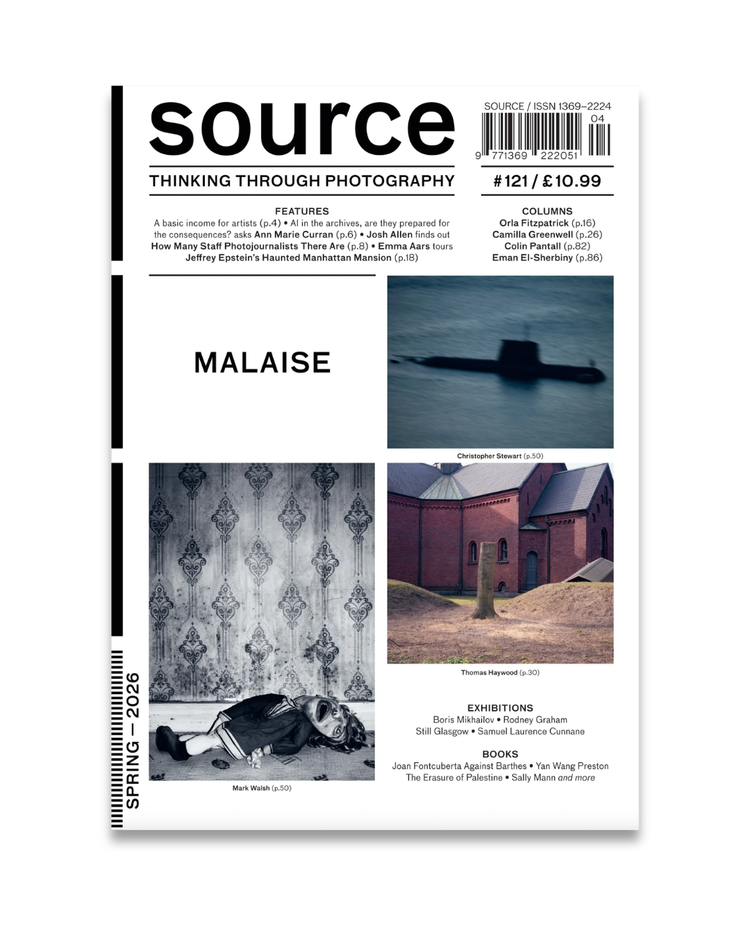
"Photography provides evidence of crimes – the smoking gun, the culprit caught red-handed – and, in an ideal world, justice follows. But more often, evidence is not so clear cut. Photographs instead identify an underlying unease, they show us that an illness is present without identifying its causes. This is apparent in the photographs of Jeffrey Epstein’s Manhattan mansion. The images were released by the US government as part of the slow and partial reveal of Epstein’s crimes. Emma Aars treats them as a behind-the-scenes tour of the infamous financier’s house. The photographs no longer function as criminal evidence, the principal culprit having already evaded justice, but as Aars notes, the house is a ‘public display of his persona’. Without being able to pick out a conclusive incriminating detail the pictures make us ask, if it wasn’t always obvious, that something was wrong.
Thomas Haywood’s Weeping Rocks came out of a feeling that "as old certainties disappear and the world seems more threatening people retreat inwards. Lives go on behind tall hedges, fences and improvised barriers, but the rumbling malcontent of nature will follow". Julia Tanner introduces the work noting "Redolent of Chernobyl or an imagined post-apocalyptic landscape of the future, the images draw on cinematic iconographies of disaster as well as photographic traditions exploring sociopolitical realities from Walker Evans to Robert Frank".
Christopher Stewart’s work The Colony was initially two bodies of work. In 2012 authorities in Sydney moved a colony of grey head ed flying fox bats using pre-dawn noise disturbance to prevent them becoming established in the city’s Botanical Gardens. The aim was to protect heritage-listed trees but Stewart, who had been photograph ing the bats prior to this, was struck by parallels between the migrant colony of bats and the political rhetoric at the time in Australia which was overtly anti-migrant. At the same time Stewart was photograph ing regular military exercises designed to counter China’s influence. After working on the two parallel series for some years he began to understand their inter-relationship. "The protection of borders; the annexation of territory; the forced displacement of populations: these themes began to emerge as the images were considered side by side".
Mark Walsh’s work Towards an Empty Sea has its origins in a chance visit to an old derelict house by a river. Wallpaper depicting nature had become stained by damp and mold: "It was as if the river was growing up through the house, absorbing all that human experience into itself". Walsh is interested in the idea of following a river to the sea as an exercise in escape and enlightenment in contemporary cul ture. This motif is found in different stories like the symbolic freedom of the river in Francis Ford Coppola’s Rumble Fish and The Night of the Hunter the American Southern Gothic horror-thriller film direct ed by Charles Laughton in which children escape their pursuer in a boat down a river. But for Walsh there is no wisdom or redemption at the end of our flight down the river, "just a black sphere, like a single atom, a cold entity floating on the sea, the beginning and the end". (Words by Source Editors)
Description
"Photography provides evidence of crimes – the smoking gun, the culprit caught red-handed – and, in an ideal world, justice follows. But more often, evidence is not so clear cut. Photographs instead identify an underlying unease, they show us that an illness is present without identifying its causes. This is apparent in the photographs of Jeffrey Epstein’s Manhattan mansion. The images were released by the US government as part of the slow and partial reveal of Epstein’s crimes. Emma Aars treats them as a behind-the-scenes tour of the infamous financier’s house. The photographs no longer function as criminal evidence, the principal culprit having already evaded justice, but as Aars notes, the house is a ‘public display of his persona’. Without being able to pick out a conclusive incriminating detail the pictures make us ask, if it wasn’t always obvious, that something was wrong.
Thomas Haywood’s Weeping Rocks came out of a feeling that "as old certainties disappear and the world seems more threatening people retreat inwards. Lives go on behind tall hedges, fences and improvised barriers, but the rumbling malcontent of nature will follow". Julia Tanner introduces the work noting "Redolent of Chernobyl or an imagined post-apocalyptic landscape of the future, the images draw on cinematic iconographies of disaster as well as photographic traditions exploring sociopolitical realities from Walker Evans to Robert Frank".
Christopher Stewart’s work The Colony was initially two bodies of work. In 2012 authorities in Sydney moved a colony of grey head ed flying fox bats using pre-dawn noise disturbance to prevent them becoming established in the city’s Botanical Gardens. The aim was to protect heritage-listed trees but Stewart, who had been photograph ing the bats prior to this, was struck by parallels between the migrant colony of bats and the political rhetoric at the time in Australia which was overtly anti-migrant. At the same time Stewart was photograph ing regular military exercises designed to counter China’s influence. After working on the two parallel series for some years he began to understand their inter-relationship. "The protection of borders; the annexation of territory; the forced displacement of populations: these themes began to emerge as the images were considered side by side".
Mark Walsh’s work Towards an Empty Sea has its origins in a chance visit to an old derelict house by a river. Wallpaper depicting nature had become stained by damp and mold: "It was as if the river was growing up through the house, absorbing all that human experience into itself". Walsh is interested in the idea of following a river to the sea as an exercise in escape and enlightenment in contemporary cul ture. This motif is found in different stories like the symbolic freedom of the river in Francis Ford Coppola’s Rumble Fish and The Night of the Hunter the American Southern Gothic horror-thriller film direct ed by Charles Laughton in which children escape their pursuer in a boat down a river. But for Walsh there is no wisdom or redemption at the end of our flight down the river, "just a black sphere, like a single atom, a cold entity floating on the sea, the beginning and the end". (Words by Source Editors)
You May Also Like